Welcome to the dissertation page for Warren
Buckleitner. THE RELATIONSHIP BETWEEN SOFTWARE INTERFACE
INSTRUCTIONAL STYLE AND THE ENGAGEMENT OF YOUNG
CHILDREN ABSTRACT: This study examined the relationship between
software interface design and child engagement by exposing
38 preschool-age children to two computer sorting
activities. These activities were identical except for
design characteristics that could be associated with two
common teaching styles. In one of the conditions, called
"high computer control" (HICOMP), children were prompted and
reinforced with each task, resulting in a less responsive
experience. The other condition, called "high child control"
(HICHILD) provided minimal instructions and reinforcements.
The outcome variables were the number of tasks attempted,
tasks correct, time with the activity, mouse clicks and a
child rating of the experience. In addition, anecdotal
observations documented child reactions to both
settings. Children in the high child control treatment were more
active, completing more tasks (mean = 64 vs. 20; p <
.05), clicking the mouse more times (mean = 129 vs. 73; p
< .05), and getting more tasks correct (mean = 41 vs. 16;
p < .05). Children rated both experiences highly, and
spent about the same amount of time with each condition. In the high computer control setting, there were more
clicks per task (mean = 4.07 vs. 2.09; p < .05), and
children had a higher accuracy level (mean = 85% vs. 68%
respectively). In addition, ANOVA procedures suggested that
younger choose to stay with the HICOMP experience longer
than the older group of children. This study helps connect the established principles of
human/child interaction to computer/child interaction,
including the role of external reinforcements in instruction
and the level of responsivity of the interaction. The
results suggest that designers and evaluators of interactive
media products for children should pay careful attention to
the degree to which the implementation of control mechanisms
such as reinforcements can have substantial effects on
children's interaction with the software. The files below contain additional information, including
the dissertation, various collection forms with names
removed and some video footage. If you have a Macintosh, it
is useful to download the Cookie Critters activity and play
with the preferences settings. This way you can experience
the activity through the eyes of one of the children. I
think this is the best way to quickly understand this
study. --> DO THIS FIRST. View the same child in both the
high and low control experimental settings as a QuickTime
movie--> Download
.mov file --> Read dissertation
as a PDF --> Read dissertation in Microsoft Word -->
Download
file --> Get to know some of the population. View 14 slides
in Quicktime --> Download
.mov file --> Cookie Critters 2x for Macintosh, unstuffed -->
Download
6 MB file --> Cookie Critters 2x for Macintosh, stuffed -->
Download
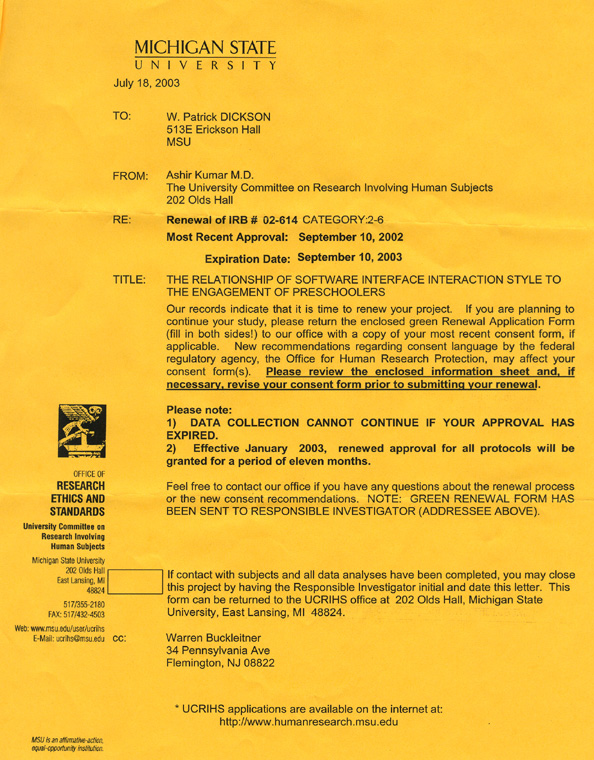
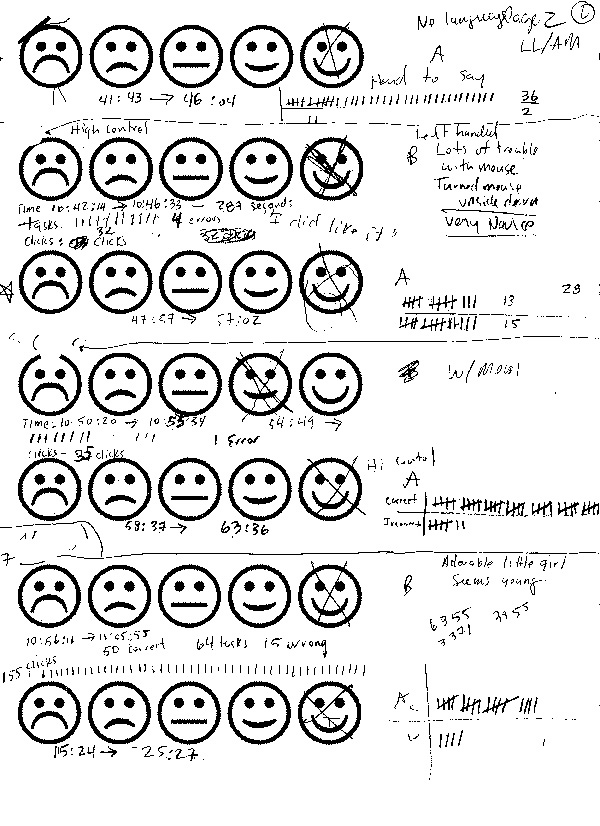
3.2 MB file --> Parent permission slip --> jpg --> UCRIHS human subjects form --> jpg --> Data collection sheet sample for session 1 -->
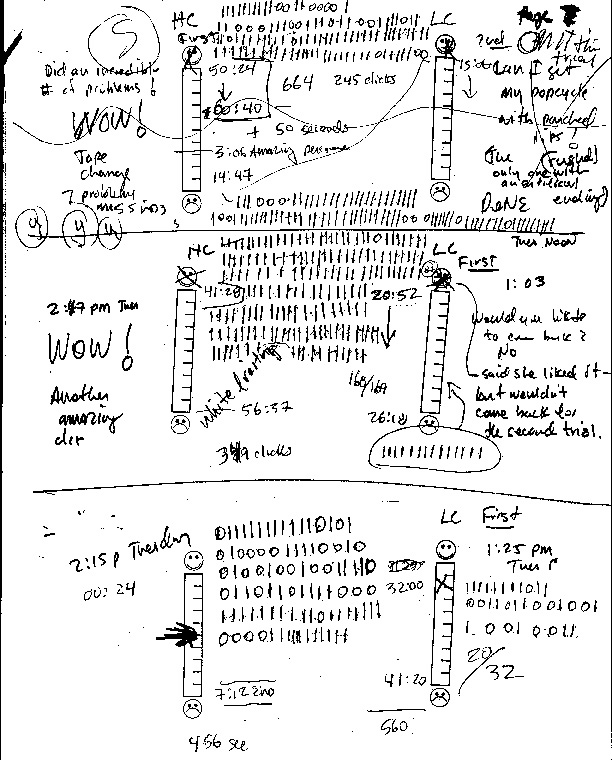
graphic --> Data collection sheet sample for session 2 -->
graphic --> View data in Microsoft
Excel
Copyright 2004
Comments? Questions? Contact me by email
908-284-0404 (phone)